
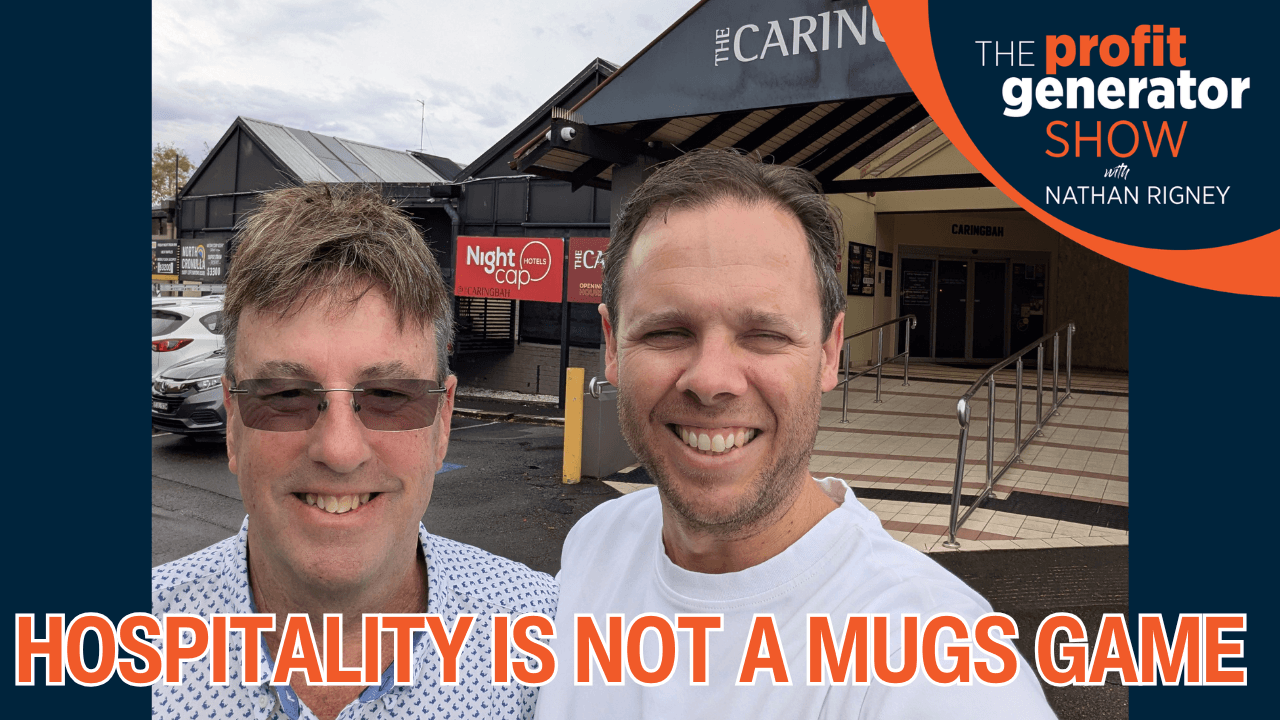
There’s a line in an underrated Aussie film from 2002 (Dirty Deeds) that nails hospitality in one sentence:
“Restaurants are a bloody mugs game.”
Up at 5 am. Food runs. Staff dramas. Still there at 1 am.
If you’ve ever owned (or thought about owning) a café, bar, pub or restaurant, you already know exactly what that means.
But here’s the truth:
Hospitality isn’t a mugs game.
Running it without systems is.
In this episode of the Profit Generator Show, I sat down with hospitality consultant Steven Mulligan (Number Krunchers), a Profit First Advisor who’s lived on both sides of the fence: accounting firm and restaurant operator.
And we went straight into the reality of why hospitality businesses struggle to make money… even when they’re busy.
Why Hospitality Feels Like the Money Just Disappears
Hospitality is the fastest-moving industry I see.
Money comes in quickly… and it flies out even faster.
There are so many spinning wheels:
- stock ordering
- suppliers
- staff rosters
- wastage
- customer experience
- EFTPOS fees
- delivery platforms
- compliance (workers comp, licenses, payroll, tax)
- theft risk (not just cash, food and stock too)
And the worst part?
Most owners are working in the business so hard that they never get time to work on the business.
So when things go wrong, they don’t fix the system… they just push harder.
That’s where the mugs game begins.
The Biggest Shift: Cash Is Gone (And So Are the Old “Extra Margins”)
Twenty years ago, hospitality had a “buffer” that many operators relied on: cash.
Cash gave some businesses breathing room.
Whether it was tips, side margin, or “creative accounting”, cash was part of the ecosystem.
Now?
People don’t carry cash. Everyone taps. Everything shows up.
Which means modern hospitality has no hiding place.
If you’re not profitable on paper, you’re not profitable, full stop.
Steven’s Practical Fixes: Make the Business Profitable First
We covered a heap, but here are the big business-focused takeaways that matter.
1) Your menu is probably too big
This one is brutal because it’s common.
Most venues try to be everything to everyone.
But that creates:
- too many ingredients
- too much stock
- too much waste
- slower service
- more errors
- more stress
Smaller menu = less wastage + faster output + better margin.
And here’s the lesson:
It’s better to be known for something than known for nothing.
2) Stop bulk buying “for discounts”
Suppliers love convincing you to over-order.
But you know what over-ordering really is?
Cash sitting on shelves.
Even if it “doesn’t go off”, it’s still money not working for you.
Steven shared an example of a venue sitting on ~$25,000 worth of liquor stock behind the bar.
Looked impressive. Didn’t move. Didn’t make money.
That’s not inventory, that’s a shrine to poor cash flow.
3) Every dollar in your venue needs to make money
This is one of the most important lines from the episode.
If you’ve got $25k sitting in stock:
- it should be turning
- it should be earning margin
- it should be funding wages and growth
If it’s not turning? It’s not an asset, it’s a dead weight.
The same goes for:
- equipment you don’t use
- subscriptions you don’t need
- menu items that don’t sell
- staff hours that don’t produce ROI
4) Your front-of-house team are sales staff
This is where most venues lose money without noticing.
Wait staff aren’t “plate carriers”.
They control:
- upsells
- second drinks
- dessert conversion
- coffee conversion
- experience (which drives repeat business)
Steven told a story about an owner wanting to lift the spend per head by $15.
The honest answer?
You’ll never lift spend per head if customers can’t get served after mains.
That extra $15 comes from:
- another drink
- dessert
- coffee
- a suggestion
- a staff member paying attention
If no one asks, it doesn’t happen.
5) “How do you feel when you walk in the door?”
This was one of the simplest but most powerful moments.
Steven does mystery diner audits.
And one venue had a problem straight away:
- no welcome
- no engagement
- cold, uncomfortable environment
- staff disorganised and duplicating tasks
Customers were uncomfortable, so they rushed.
And if customers rush:
- they don’t stay
- they don’t order more
- they don’t come back
Hospitality is emotional. People buy on feeling.
If you don’t control the experience, you don’t control the spend.
The Real Problem No One Talks About: Business Ownership Isn’t Taught
Here’s the part I agree with Steven on 100%:
People will pay for TAFE.
They’ll pay for uni.
They’ll pay to learn how to be a chef.
But almost no one invests in learning how to be a business owner.
And hospitality punishes that harder than almost any other industry.
Because you can be brilliant at food… and still go broke.
So… Is Hospitality a Mugs Game?
Only if you run it on:
- passion without systems
- big menus
- messy stock
- poor training
- no spend-per-head tracking
- no financial visibility
But if you run hospitality like a real business?
It can absolutely be profitable, and it can even become something you can sell one day, instead of something that consumes you.
Want Help Making Your Venue Profitable?
If you’re in hospitality and you’re sick of working insane hours for thin margins, this is where to start:
✅ Get your numbers clean
✅ Build systems
✅ Track spend per head
✅ Control stock
✅ Train your team to sell
✅ Stop cash leaking through the cracks
If you want help with the accounting, cash flow systems, and building a profitable structure around your business, reach out to me.
And if you want a hospitality specialist who lives and breathes this industry, Steven Mulligan from Number Krunchers is the real deal.